
 Version imprimable
Stéfanie Prezioso --- How would you describe the system of power that Orbán put in place over these sixteen years? Some speak of a mafia capitalism, others of a kind of "neo-royalism" to account for a system that has profited outrageously from the presidential clan?
Former liberal minister Bálint Magyar [1] describes it as a post-communist mafia state. This is not ordinary corruption coexisting with a degraded rule of law, but the criminalisation of the state itself. Public resources, public procurement, the media, and judicial institutions are systematically leveraged for the benefit of a network of clans organised around the Prime Minister. Between 3.2 and 5.5 billion euros of European funds have benefited a narrow circle linked to the regime, led above all by the companies of Lőrinc Mészáros [2], Orbán’s closest oligarch.
Illiberal democracy is the term Orbán himself claimed from 2014, before preferring the formula Christian democracy. Freedom House [3] classified Hungary as only partly free. What is specific to the Hungarian model is its method: the capture of institutions was achieved through parliamentary means, thanks to the two-thirds majority obtained in 2010, without a coup d’état. This is precisely what made it an exportable model --- but also one perfectly serviceable for the muscular liberals of the new government.
How did Orbán manage to rise to the level of an indispensable reference figure for the global far right, from the United States to Italy? What might be the impact of his electoral failure on his Russian, European, and American "friends"? What might be its direct impact on Robert Fico’s Slovak far right?
The most accurate formulation is that proposed by Czech journalist Jan Bělíček [4] : what Pinochet was for the neoliberals, Orbán was for the Christian nationalists --- a proof of concept. Pinochet demonstrated that the neoliberal programme could be applied against democratic resistance before becoming electorally viable elsewhere. Orbán demonstrated that a liberal democratic system can be hollowed out from within, without a coup d’état, whilst maintaining the electoral facade, and simultaneously neutralising the press, the judiciary, the universities, and the rules of the electoral game.
What the American ultra-conservatives admired in Orbán’s Hungary was the relentless war against progressive thought, the capture of the state apparatus, the dismantling of judicial power, and the creation of a political environment in which the opposition has practically no chance. This is precisely what they would like to reproduce at home.
Orbán’s defeat has asymmetric effects depending on the actor. For Trump and Vance, it is the loss of the most useful ally within the European Council --- the one who blocked collective decisions on Ukraine, including the 90-billion-euro loan to Kyiv that Orbán had vetoed. For Putin, it is the loss of the most accommodating European government on energy and sanctions. For European far-right parties, it is the signal that the model is not election-proof.
Slovak Prime Minister Robert Fico does not rejoice at Orbán’s defeat. But Fico did not build his political survival on direct reference to the Hungarian model: his red-brown electoral base rests on other foundations, notably what I analyse in my article on Slovakia [5] as an anti-Western posture rather than a pro-Russian one.
After sixteen years in power, Viktor Orbán appears weakened in certain working-class regions such as Dunaújváros. Why is his party, Fidesz, experiencing an erosion of its popular base?
Working-class towns such as Dunaújváros [6] do not constitute the core of Orbán’s electoral base. Dunaújváros is a steel-industry town, built under the name Sztálinváros in the Soviet era, historically left-leaning. Its shift towards Fidesz is relatively recent and represents an electoral acquisition, not a historical stronghold. The heartland of the Fidesz vote remains rural Hungary, the small towns and villages of the east and south of the country. The erosion of the Orbán vote in Dunaújváros signalled that working-class voters converted by Orbán were beginning to leave him.
This erosion stems from several factors. First, economic deterioration: persistent inflation, stagnant real wages, and a near-freeze of EU transfers --- nearly 20 billion euros blocked --- translating concretely into postponed infrastructure projects. Second, scandal saturation: the presidential pardon granted in 2023 to a person convicted in a paedophilia case, and the documentary La Dynastie [7], viewed three million times in ten days on YouTube, which documented the enrichment of the Orbán clan.
Is the deterioration of living standards the principal cause of the shift in the electoral balance of power against Orbán’s party? Does the Fidesz nationalist-identitarian discourse still play as significant a role within Hungarian public opinion, notably against the EU but also against Ukraine? Can growing tensions with Ukraine play in his favour?
Both factors coexisted, but their relative weight was shifting. Initially, the nationalist-identitarian discourse functioned as a substitute for material improvement during the years when economic growth --- fed in part by European transfers --- made it possible to mask inequalities. The strategy of confrontation with Brussels ultimately backfired against the regime: the delays linked to the fund freeze became visible --- postponed projects, scarcer subsidies.
A functioning identitarian mechanism nonetheless remained: the Ukrainian question. Orbán’s policy of "pragmatic non-alignment", analysed in detail by Bálint Demers on ESSF. The tensions around the Druzhba pipeline [8], weaponised during the election campaign, were part of this logic. Orbán even used the discovery of explosives near the TurkStream [9] pipeline in Serbia on 6 April to attempt to blame Ukraine; Serbian intelligence services quickly denied this. But, as Dávid Csillik [10] noted on the Hungarian progressive site Mérce, neither Orbán nor Magyar responded to the pre-electoral package of demands from the Hungarian Trade Union Federation --- the identitarian discourse masked the absence of a social programme.
Viktor Orbán is strongly supported by the United States of Donald Trump and JD Vance. The latter travelled to Hungary to support his election campaign. Is this really an asset for him, when the European far right seems increasingly embarrassed by Washington’s hostility towards the EU and, more recently, by the consequences of the war in Iran? After Meloni’s failed referendum on Italian justice, could Orbán not be the first victim of this political conjuncture?
On Vance’s visit: Jan Bělíček, in his article on ESSF [11], identifies several ironies. Vance delivered a speech on Christ and the Christian foundations of European civilisation before a comparatively secular Hungarian audience. He invoked workers’ rights without saying a word about the tech billionaires enriched under Trump. And he denounced Brussels bureaucrats for "making millions" whilst saying nothing of the oligarchy that Orbán himself built. The electoral effect of the visit is close to zero: Vance is little known in Hungary, and it was not Trump who came. But consider the concrete cost: in exchange for the visit, Hungarian oil company MOL [12] committed to purchasing 500 million dollars (approximately 460 million euros) of American oil, and the Hungarian army 700 million dollars (approximately 645 million euros) of HIMARS [13] systems --- 1.2 billion dollars (approximately 1.1 billion euros) at the expense of the Hungarian taxpayer, in direct contradiction with the rhetoric of national sovereignty.
Is Orbán not severely handicapped by his close collusion with Putin’s Russia and the corruption affairs that accompany it?
Orbán’s relationship with Russia is not primarily ideological but structural and economic, centred on cheap Russian gas and the construction of the PAKS-II [14] reactors by Rosatom.
At the level of popular voting for politicians like Orbán and Fico, as I developed in my article on Slovakia [15], this phenomenon does not reflect pro-Russianism in the strict sense, but anti-Westernism. The populations that support these postures do not want more Russia in their lives --- they want less of the West. And "less of the West" means for them a less cruel economic system, stronger rights for the majority, more comprehensible political decision-making, and a more communal way of life. This real demand is captured and distorted by Orbán to the benefit of energy vassalage to Moscow. Magyar’s victory does not resolve this demand.
Péter Magyar and the Limits of the Political Alternation
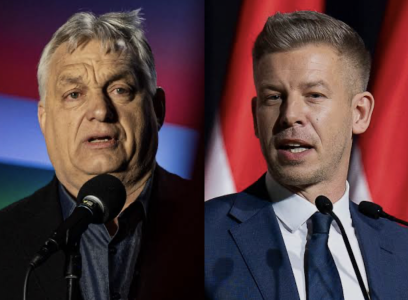
Péter Magyar is Orbán’s principal rival. He is given as the winner by opinion polls, although the outcome was not certain. Yet he comes from the same political milieu, which he broke with in 2024. On what points does he differ from his rival? On what themes can he win a majority of the electorate? If he were defeated, could Orbán contest the election results in the manner of Trump?
Magyar was not a leading political operator within Fidesz, but was embedded in the party’s social milieu through his marriage to former Justice Minister Judit Varga [16] . His break in February 2024 was triggered by that scandal: President Katalin Novák [17] had pardoned a convicted person, Varga had countersigned. He founded the Tisza party (Respect and Freedom [Tisztelet és Szabadság]) and obtained 29.6% at the European elections of June 2024. He positions himself as an anti-corruption technocrat and promises to unblock the billions in frozen European funds.
As András Borbély explains on Mérce, Magyar does not carry an alternative proposal for social organisation. The two major parties of 2026 did not campaign on two different social projects, but on the interests of two competing power structures. On Ukraine, Tisza supported Orbán’s position in the European Parliament by voting against the sending of arms or troops.
The real question is not whether Orbán will contest the results --- he did not --- but whether Tisza’s super-majority (138 seats out of 199, i.e. the two-thirds required to amend the constitution) will be sufficient to dismantle the institutional network built over sixteen years: appointments to the Constitutional Court, the public prosecutor’s office, regulatory authorities, which extend well beyond a single term in office. Perhaps Tisza will prefer to make use of the post-communist mafia state rather than reform it according to Brussels’ preferences.
Orbán endlessly criticises Brussels whilst benefiting from European funding. Over the past sixteen years, Hungary has received tens of billions of euros in EU transfers, representing 4 to 5% of its GDP and, according to estimates from the Corruption Research Center in Budapest, 3.2 to 5.5 billion euros would have benefited a narrow circle of actors linked to the regime. Beyond the anti-EU discourse, how has Europe served as a lever for his regime? Does this anti-EU discourse remain effective with his electoral base when corruption extends to all spheres of the regime?
The mechanism is simple: European funds arrive in Budapest; the government chooses the beneficiaries; companies linked to the Orbán network sweep up the contracts. The government can simultaneously attack the EU rhetorically and depend on it structurally --- because the rural electoral base does not see the redistribution mechanism, and because the media controlled by Fidesz ensure that scandals do not break through. The documentary La Dynastie, viewed three million times in ten days, signalled that this firewall was beginning to crack.
During his pre-electoral visit to Budapest, Vance denounced Brussels bureaucrats for making millions, whilst saying nothing about the tech billionaires enriched under Trump --- exactly the same rhetorical structure that Orbán employs to designate Brussels as the external enemy and conceal the domestic oligarchy. The progressive freeze on funds since 2022 --- nearly 20 billion blocked according to Chatham House [18] --- ultimately made the confrontation strategy costly in concrete terms. Tisza’s victory should enable their unblocking, which represents for Brussels a powerful incentive to cooperate with the new government.
The generational fracture appears to be a key aspect of Orbán’s decline in voting intentions. For what reasons are young people, particularly in urban areas, rejecting his authoritarian ultra-conservative rule with increasing force?
Age was, according to polls analysed by Euronews [19], the primary determining factor in voting intentions: only 10 to 12% of young voters supported Fidesz, compared to approximately 60% for Tisza. Several mechanisms explain this fracture. First, emigration: hundreds of thousands of young qualified Hungarians have left the country, attracted by higher wages in Western Europe. Second, the capture of higher education: the fate of Central European University (CEU) [20], forced to leave Budapest under the Lex CEU law of 2017 and relocate to Vienna, is symbolic. Third, cultural questions: anti-LGBT legislation and state-imposed conservatism contradict the norms of a generation socialised in an open European space.
Vance delivered his speech on Christ and the Christian foundations of European civilisation before a comparatively secular Hungarian audience. The junction between American Christian nationalism and Hungarian youth could not work --- and it did not work.
The young vote for Tisza is a vote against Orbán more than a vote for an alternative social project. The unsatisfied social demand that fuelled Orbánism for sixteen years does not disappear with him.
The electoral left is entirely absent from the new Hungarian parliament. What happened?
The collapse of the Hungarian electoral left is not a campaign accident: it is structurally determined by the very conditions of the post-communist transition and by the strategic choices of the past two decades.
The Hungarian Socialist Party [21] (MSZP) governed Hungary for much of the 1990s and 2000s. But it is the direction it chose once in government that sealed its fate. The MSZP gradually transformed itself into a protest party whose only political programme became "drive Orbán from power and prevent him from returning". The European socialist path was replaced by what might be called cut-price Atlanticism --- the conviction that the values of "Brussels" are automatically the values of the party.
In doing so, the MSZP abandoned its working-class base. In the 1990s, a third of the electorate voted for it. This support rested on an organic relationship with trade unions and industrial communities. The party’s conversion to neoliberalism --- the Hungarian socialists were often more ardent defenders of market policies than their conservative opponents --- severed this link. Where Fidesz captured working-class frustration through economic nationalism and clientelism, the MSZP offered nothing.
The decline does not result solely from poor decisions but from broader historical processes. The familiar form of social democracy will not be what gives voice to the accumulated anger of the coming period. As Gábor Scheiring [22] notes in his article on Mérce, illiberalism emerged as a response to a triple devaluation: the material security, cultural status, and political voice of the working classes simultaneously declined --- and centre-left parties failed to respond.
The opposition space has thus restructured itself around Tisza --- a moderate right-wing anti-corruption party --- and around the Our Homeland Movement [23] (Mi Hazánk), the sole far-right party to have obtained seats. The electoral left, in the programmatic sense of the term, is absent from parliament. Tisza does not fill this void: it did not respond to trade union demands and proposes no alternative social programme.
What is the impact of the Hungarian elections on European politics?
Tisza’s victory constitutes a blow to the European radical right at several levels. Hungary has just overturned the oldest and most consolidated illiberal regime in Europe. Orbán demonstrated that the model can hold for sixteen years; his defeat demonstrates the inverse --- that deliberately skewed systems can nonetheless produce changes of government when electoral pressure is sufficiently massive.
For the institutional European Union, Magyar’s victory immediately removes several blockages. The 90-billion-euro loan to Ukraine, vetoed by Orbán, should be able to be unblocked [24]. Frozen European funds will be progressively released as the new government demonstrates credible institutional reforms.
On the relationship with Moscow and the Ukrainian question, the break will be real but partial. Hungary remains structurally dependent on Russian gas and Russian financing for PAKS-II --- diversification takes years. The new government will continue to demand that European aid to Ukraine be conditional on the resumption of oil and gas deliveries via the Druzhba pipeline, a position on which Tisza supported Orbán in the European Parliament. It will not provide bilateral military or civilian aid to Ukraine, but will be markedly less inclined to veto collective European initiatives --- which in itself represents a substantial change.
On Ukrainian EU membership: Tisza remains vocally opposed to accelerated accession. This is a position that corresponds in any case to that of many member states who support accession in principle whilst deferring it in practice. The promise of a fast-track for Ukraine is more rhetorical than programmatic. On this point, the change of government in Budapest will not substantially modify the European dynamic.
14 April 2026
This article first appeared in French on [Marx21.ch-https://marx21.ch/orban-battu-autopsie-de-seize-ans-dilliberalisme/]. Translated by the author for ESSF.